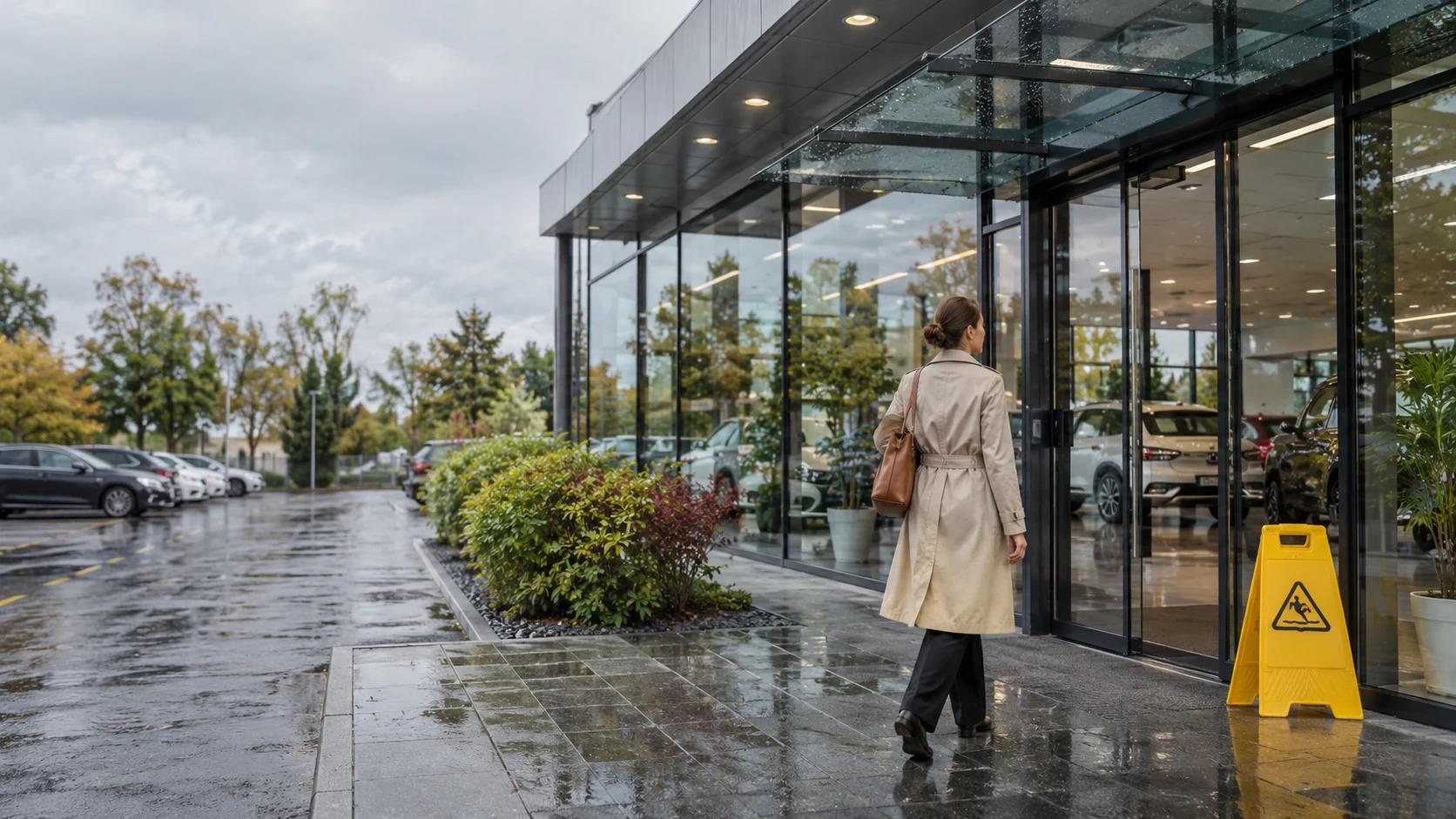
General liability
Customer injuries. Damage to other people’s property.
General liability addresses claims that your premises or work injured someone or damaged their property. For automotive businesses, separate these claims from driving accidents and damage to cars left in your care.
What it protects
Customer injury and third-party property claims.
The key distinction
Customer cars need a separate custody check.
Start your review
Match the insured locations and activities.
What it can pay for
Look for the covered cause of the injury or damage, not just where the incident happened.
Premises accidents
A visitor trips on a damaged walkway and seeks compensation. Defense and covered damages can fall under general liability.
Non-auto operations
Your work accidentally damages someone else’s property. The activity must fit the policy and avoid exclusions, including auto and care, custody or control restrictions.
What belongs elsewhere
A customer’s car in your care
Damage to a car held for service or parking is a garagekeepers question. A premises liability limit is not a vehicle damage limit.
Read the explanationEmployee injuries or driving accidents
Work injuries belong under workers’ compensation; driving liability needs the appropriate garage or commercial auto coverage.
Read the explanationA visitor falls in the parking area
Illustrative example — the policy terms and facts determine the outcome.
- 1
The incident
A customer trips over a broken curb and alleges the business failed to maintain the walkway.
- 2
The coverage question
Was this a covered premises incident at an insured location? The insurer examines the allegation, exclusions and liability.
- 3
Keep the evidence
Save incident photos, witness details and maintenance records. Report the claim using the policy’s instructions.
Read these parts of your policy
| Find this | What to check | Why it matters |
|---|---|---|
| Declarations | Correct legal business name, addresses and described operations. | An omitted location or activity can create a coverage problem. |
| Limits | Per-occurrence limit and general aggregate; check a separate products/completed-operations aggregate. | One claim and the policy-year total are different limits. |
| Endorsements | Additional insured wording and the work or location it applies to. | A certificate alone does not add someone to the policy. |
| Exclusions | Auto, customer property, repair work and other activity restrictions. | Do not assume a broad policy title covers a specific operation. |
Your practical checklist
Use these boxes as you gather the details. They stay on this page; nothing is submitted.
Common questions
Does this cover cars parked on my lot?
Not simply because the cars are there. A customer’s injury in the lot and damage to their car are different claims. Custody, the cause of damage and the policy wording matter.
Is general liability the same as garage liability?
No. Garage or auto-dealer forms address automotive operations and may combine premises and auto liability. Read the issued form to see where each part sits.
Does a certificate prove a landlord is covered?
It is evidence of insurance, not a change to the policy. Additional insured status comes from the applicable policy endorsement.
Coverage depends on the issued policy, endorsements, limits, deductibles and facts of the loss. Examples are illustrative. Submitting an application does not start or change coverage.
Further reading
Triple-I: commercial general liability ↗Oregon DAS: garage and garagekeepers coverage ↗Your next step
Put your coverage comparison to work.
Start with your business details and the coverage you want to review. Add current policies and schedules if you have them.